- Invisible Rules
- Posts
- The Invisible Rules Running Your Life
The Invisible Rules Running Your Life
(And Why Your Brain Is Being Dramatic About It)

Ujwal Arkalgud
April 16, 2026
Let me ask you something embarrassing.
When was the last time you had a genuinely exciting idea — and talked yourself out of it before anyone else even got the chance?
I'll wait.
Yeah. That's what I thought.

Gif by cheezburger on Giphy
Here's what's wild: you didn't need a critic. You didn't need a skeptical boss or a dismissive parent or a friend who just wants to be realistic. You handled it yourself. Efficiently. Preemptively. Like a one-person demolition crew for your own ambitions.
That's not a confidence problem. That's an invisible rule doing its job.
What Even Is an Invisible Rule?
As a cultural anthropologist, I've spent years studying what I call Invisible Rules — the unspoken cultural scripts that quietly determine who is allowed to lead, which paths count as legitimate, and what success is supposed to look like for someone like you.
They don't show up as instructions. Nobody hands you a rulebook at birth (or at graduation, or at that first corporate all-hands meeting). These rules just... feel like common sense. Which is exactly why they're so hard to see and so easy to follow without realizing it.
Try this: close your eyes and picture someone you genuinely respect.
Who appeared?
A doctor? A philanthropist? A quietly powerful CEO in a well-tailored blazer?
Now ask yourself: why that image? Why so fast?
That wasn't random. That was a rule.
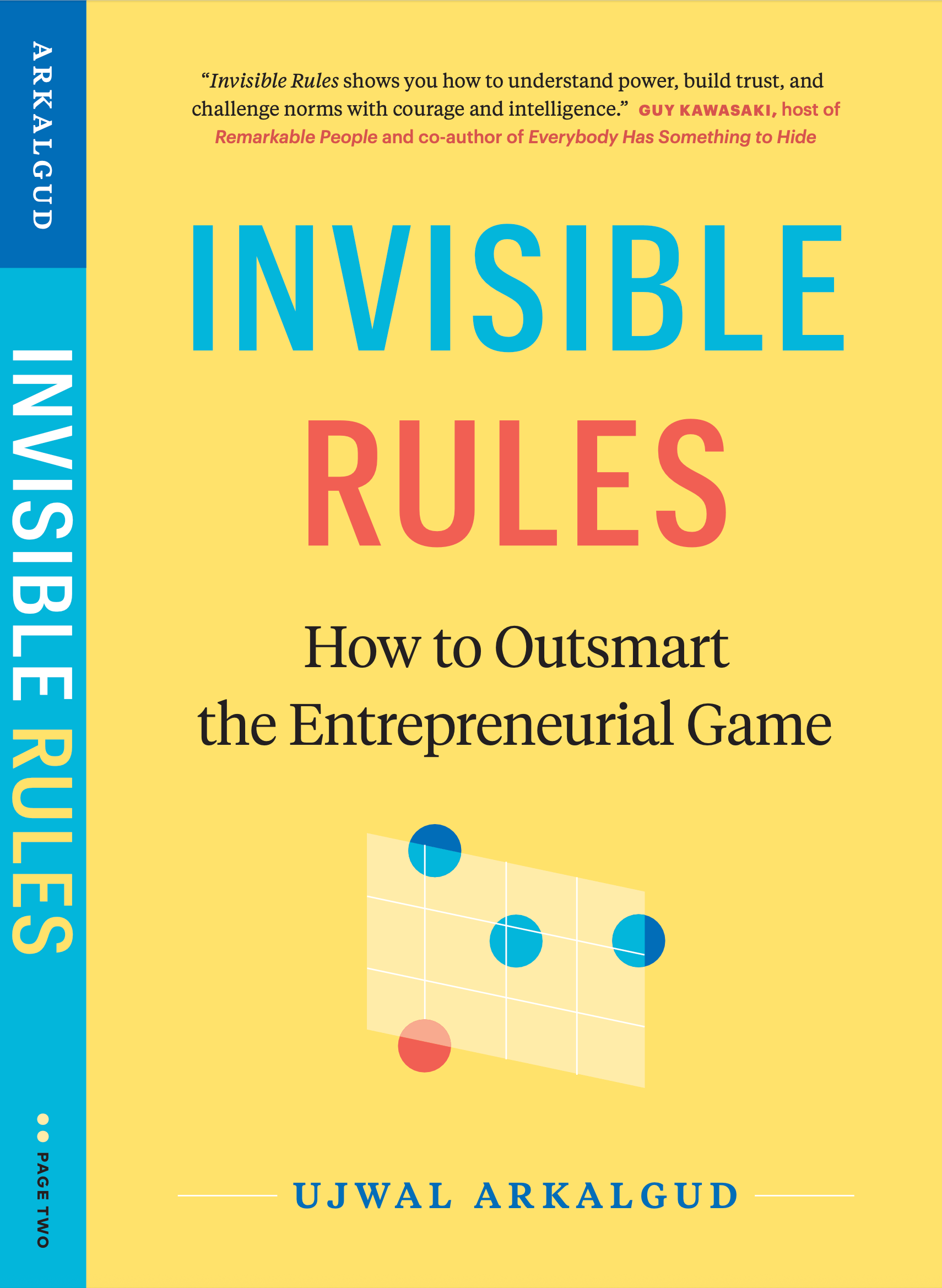
Invisible Rules is now available at your favorite online booksore
Your Brain Is Being Chased by a Tiger
Here's where it gets scientifically interesting and a little humiliating.
In the 1950s, psychologist Solomon Asch ran a simple experiment. He showed participants a set of lines and asked which one matched a reference line. The answer was obvious. Not a trick. Not a riddle. Just... lines.
But everyone else in the room (secretly in on the experiment) gave the wrong answer. And participants followed them anyway.
Not because they were confused. Not because they needed glasses.
It was a social problem. No rule was stated. No punishment threatened. And yet the rule was absolutely operating.
Modern neuroscience explains why: when we risk social rejection — raising a weird idea, standing out, violating an unspoken norm — the brain activates the same threat response as physical danger.
Your brain treats raising your hand in a meeting roughly the same way it treats being chased by a tiger.
Which means every time you've added "this is probably a dumb idea, but..." to the beginning of a perfectly good thought, your brain was technically in survival mode.
No wonder we hesitate. We're out here just trying not to get eaten.
The Time I Succeeded at Someone Else's Expectations
I know invisible rules intimately because I spent most of my early life living inside one.
I grew up in India genuinely fascinated by human behavior — culture, meaning, why people do what they do. I wanted to study social anthropology.
Instead, I was told calmly, lovingly, "That's a hobby. Not a career."
So I did the respectable thing. Engineering degree. Business degree in Canada. Job in advertising.
On paper? Solid LinkedIn profile. Very good follower count.
Internally? Deeply unfulfilled. Significant debt. Quietly numbing the gap between who I was supposed to be and who I actually was.
I thought something was wrong with me.
What I eventually realized: I wasn't failing at my dreams. I was succeeding at someone else's expectations. With honors.
What Happened When I Finally Saw the Rule
Once you can name the rule shaping your choices, something shifts. You stop being just a character in your own story and become its observer.
I realized my academic path had quietly made me "unemployable" in the field I loved. So instead of waiting for permission, I gave it to myself.
I started a company to practice anthropology in the real world. Within a year, we were advising some of the largest companies on the planet. We built a research platform combining cultural anthropology and AI — something that barely existed at the time. Grew to nearly fifty people. Eventually sold the company.
But the exit wasn't the point.
For the first time, I wasn't performing success. I was living it.
You're Already Doing This — Right Now
Here's how you know an invisible rule is running in the background: you start editing yourself before anyone else has a chance to.
You have an idea. A bold one. And immediately:
"This might be a stupid question..."
"I haven't fully thought this through..."
"This is probably unrealistic, but..."
By the time the sentence ends, the idea is already half-gone. You did the critic's job for them. Faster, and with more intimate knowledge of exactly which insecurities to target.
Students do it to avoid sounding dumb. Professionals do it to avoid looking naïve. Leaders do it to appear responsible.
Same behavior. Different costumes.
That's not personality. That's a shared invisible rule doing what it does best.
The Flip
Here's a rule almost everyone's absorbed: what you study determines what you're allowed to become.
You picked a major. Chose a discipline. And suddenly felt like you'd chosen a lane, possibly forever.
Economics? "Good with numbers." Literature? Probably law. Philosophy? People start checking in on you.
Now flip it, just as an experiment.
What if your degree isn't a lane — it's just one way of seeing the world?
Suddenly the question changes from "Am I qualified enough?" to "What do I see that others might not?"
That's the moment you stop being a passive participant in your own life. That's where things get interesting.
One Thing to Try
Invisible rules rarely tell you what to do. They tell you what not to consider. They quietly shrink the range of futures you allow yourself to imagine.
But once you see them — even once — they lose their grip.
So here's the only practice I'll leave you with:
The next time you catch yourself softening an idea, adding a disclaimer, or talking yourself out of something before anyone else has a chance — pause.
Ask: Is this a rule I've consciously chosen, or one I've simply absorbed?
Then imagine, just as an experiment, that the rule were different.
Notice what becomes visible.
That's where real change begins.
P.S. Invisible Rules is available now, get your copy here: https://www.amazon.com/dp/177458686X
Keep Reading


Reply